TL;DR
Quick Guide: the LiPo routine
A LiPo does not like extremes. Do not leave it full, do not drain it too far, do not push it hard when ice-cold and do not put it away hot.
Damage and unusual cell differences show up early.
Wrong settings are one of the most common sources of risk.
Voltage sag and over-discharge shorten battery life.
This tells you whether the setup or runtime is too demanding.
Values you actually need
The most important LiPo voltages
With multi-cell packs, the voltage per cell is what matters. A full 3S LiPo is about 12.6 V, while a 6S pack is about 25.2 V. That is why the correct cell count on the charger is not a detail, but a must.
| State | Reference value | Practical note |
|---|---|---|
| Standard LiPo full | approx. 4.20 V/cell | Do not charge above this. For normal LiPos, this is the upper limit. |
| LiHV full | approx. 4.35 V/cell | Only for batteries explicitly marked as LiHV and only in the LiHV program. |
| Storage voltage | approx. 3.75-3.85 V/cell | Many chargers target 3.80 V/cell; LiHV often targets 3.85 V/cell. |
| After use | approx. 3.6-3.7 V/cell at rest | A gentle everyday range. Directly after load, the value can look lower. |
| Critical under load | below approx. 3.3 V/cell | Avoid this especially in cold conditions and under high load. |
| Over-discharged | below approx. 3.0 V/cell | Do not continue normal use and do not charge it on suspicion. |
Read cell count quickly
Do not overrate checker percentages
Trust cell voltage more than percentage values. Battery type, age, temperature and load profile can only be estimated roughly by simple checkers.
Charging without guesswork
The correct setting beats gut feeling.
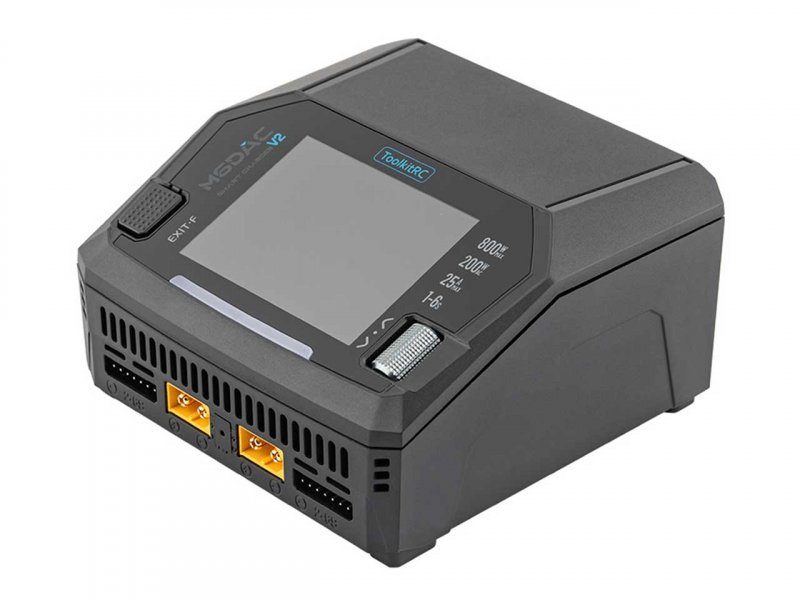
Battery, charger and balancer must match. Inspect the battery visually, choose LiPo or LiHV deliberately and use Balance Charge if the battery has a balancer connector.
1C as a clean standard
1C means the charge current in amps matches the capacity in Ah. A 2200 mAh battery is therefore charged at 2.2 A. Higher charge rates should only be used if both the battery manufacturer and charger explicitly allow them.
| Capacity | 1C charge current | Gentler range |
|---|---|---|
| 850 mAh | 0.85 A | 0.4-0.8 A |
| 1300 mAh | 1.3 A | 0.7-1.3 A |
| 2200 mAh | 2.2 A | 1.1-2.2 A |
| 5000 mAh | 5.0 A | 2.5-5.0 A |
| 7000 mAh | 7.0 A | 3.5-7.0 A |
In the model
A timer beats a stress test.
A battery is usually worked harder in the model than on the charger: high current, limited cooling, large propellers or long full-throttle runs. Good runtime is therefore achieved by measuring, not guessing.
- Start with a rather short flight or drive time.
- Then measure the resting cell voltage.
- Recharge fully and note how many mAh were put back in.
- Increase runtime only step by step.
- Set a fixed time on the transmitter or with a timer.
See C ratings realistically
The number is guidance, not a free pass.
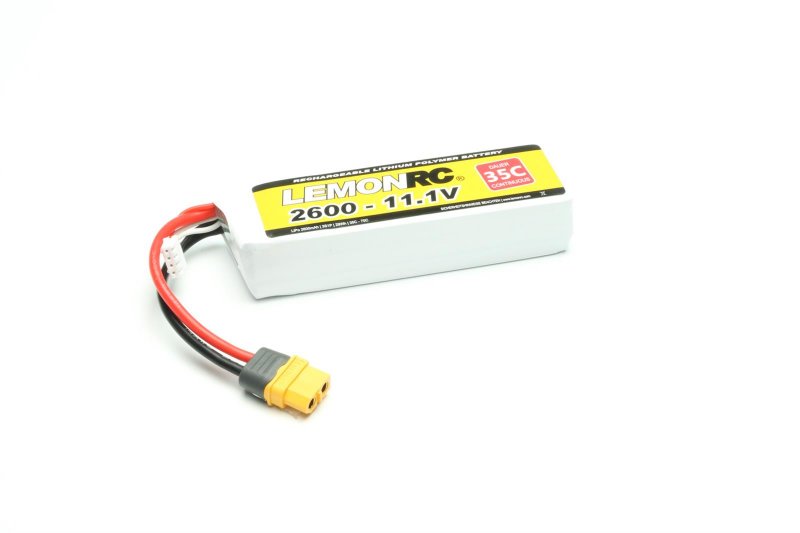
2600 mAh and 35C calculate to 91 A (2.6 Ah × 35). In practice, age, internal resistance, temperature, connectors, cables, cooling and the load profile also matter. If the battery or ESC gets unusually hot, the setup is telling you more than the label.
Battery types in the shop
The right LiPo is not only about mAh and C.
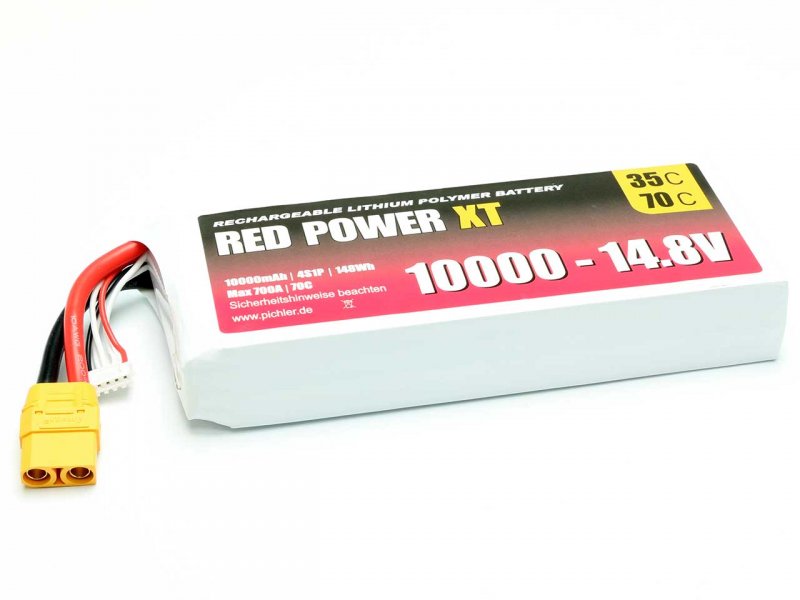
Size, weight, connector and model type matter just as much. As a quick entry point: EXTRON X2 as the budget-friendly line, LEMONRC as high-quality all-rounders and RED POWER XT as lighter packs with a more moderate C rating.
 RED POWER XT
 Cold, warm, critical
Temperature decides how healthy performance really is.
Cold makes LiPos sluggish, heat accelerates aging and increases risk. Do not push ice-cold batteries at full throttle. Let very warm batteries cool down first and look for the cause.
| Temperature | When charging | When in use |
|---|---|---|
| below 0 °C | Do not charge. | Not suitable for high current; warm up first. |
| 0-10 °C | Better bring it into a moderate range. | Power is reduced, voltage sags earlier. |
| 20-35 °C | Good practical range. | Uncritical range for normal use. |
| 35-45 °C | Only with caution; do not charge at maximum speed. | Monitor in high-performance setups and cool well. |
| approx. 55-60 °C and above at the battery | Do not charge; let it cool first. | Critical. Check runtime, propeller, current and battery. |
Storage & transport
Most LiPos die slowly, not spectacularly.
Forgetting them fully charged, leaving them over-discharged or baking them in the car in summer: these are the classics. Good storage means storage voltage, dry, cool, mechanically protected and with contacts secured against short circuits.
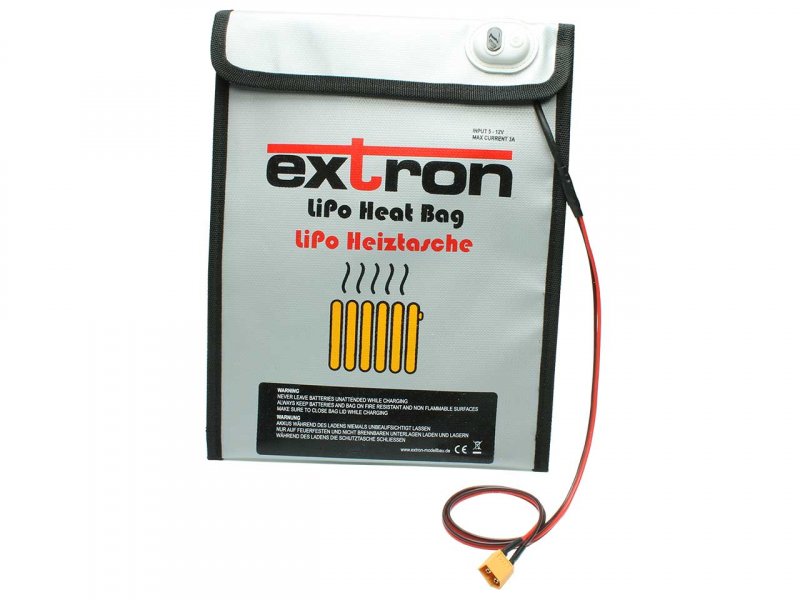
For transport, storage and temperature-controlled batteries, the EXTRON LiPo heating bag shown here is especially useful: it has room for several batteries and can be set to 20, 30 or 40 °C.
- Pausing for several days? Use the storage program.
- Weeks or months? Check voltage and condition regularly.
- Transporting? Avoid short circuits and pressure marks.
When something feels off
When in doubt, stop testing.
A battery that visibly changes or reacts unusually should be removed from service. That is not panic, it is normal workshop discipline.
Do not charge, do not keep using it, store safely and dispose of it.
Check especially critically after a crash or crushing.
Check balance charging; retire the battery if the difference is large.
Keep your distance, use a fire-safe environment and do not touch the battery.
Hand it in correctly
LiPo batteries do not belong in household waste.
Dispose of old batteries through suitable collection points, recycling centers or retailer take-back points. Tape the poles individually, protect batteries against short circuits and clearly identify damaged batteries when handing them in.
Frequently asked questions
Short answers
Can I store LiPos half full?
Yes. For longer breaks, storage voltage around 3.8 V/cell is the right target range.
How long can a battery stay fully charged?
For use on the same day, that is normal. Leaving it fully charged for several days should not become a habit.
Do I have to charge every battery slowly?
1C is a clean standard. Go higher only if the battery manufacturer explicitly approves it.
Can I still use a puffed battery for small loads?
No. A puffed battery is a warning sign and should be removed from service.
When does a LiPo heating bag make sense?
In cold conditions and high-performance setups, when batteries should be warmed evenly and in a controlled way.
Fact-check note
The key reference values were checked: standard LiPo 4.20 V/cell, LiHV 4.35 V/cell, storage around 3.80 V/cell, 1C as a conservative charge current and separate disposal with taped poles.